
I hear these conversations often: Are California’s real estate rules making the housing crisis worse, or are they finally helping fix it?
My honest answer? Both.
For decades, California made it harder and more expensive to build property than almost anywhere else in the country. But over the last few years—and especially since 2025—Sacramento has been removing many of those barriers.
The real question is whether it is happening fast enough.
The state says California needs 2.5 million new homes by 2032, with at least one million designated for lower-income families. Through July 2026, the state had permitted 64,673 units for the year. That means we are building at roughly one-third of the pace called for under the state’s own plan.
Why Some Say Regulation Is Hurting
If you talk to developers, they will tell you California’s regulations function like a tax on every new property. The numbers appear to support that argument.
RAND examined 144 projects across California, Texas and Colorado. Here is what stood out:
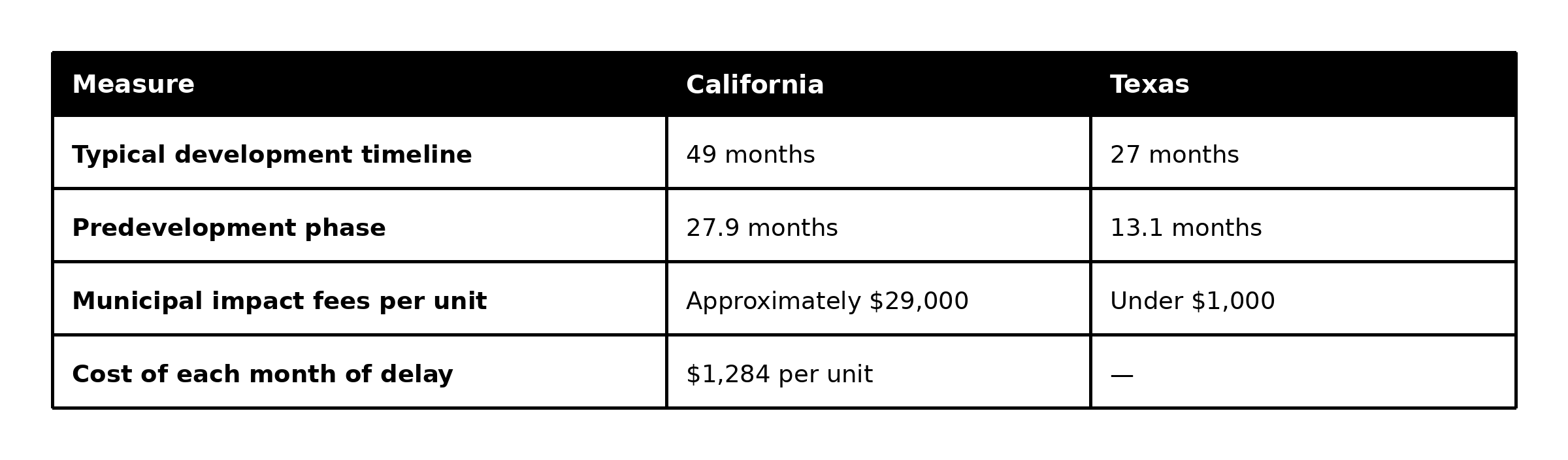
That is nearly two additional years to complete the same building.
Where does all that additional cost come from?
Time is money. While a project waits for approvals and inspections, the developer continues paying interest, taxes and rising material costs. RAND estimates that delays alone add approximately 8% to total costs.
Fees add up. California’s impact fees are approximately three times the national average. In the Sacramento area, one industry study estimates government fees at roughly $109,000 per new single-family home—and that is before pouring the foundation.
CEQA lawsuits create delays. For years, anyone who opposed a project could potentially tie it up in court under the state’s environmental review law, including infill developments in neighborhoods that were already built out.
Design and labor mandates increase expenses. RAND found that prevailing-wage requirements account for a significant portion of the cost difference for subsidized affordable housing. Overly specific design requirements can also raise architecture and engineering costs.
Rent control can have unintended consequences. A well-known Stanford study of San Francisco found that landlords affected by rent control removed 15% of their units from the rental market through condo conversions and redevelopment. According to the study, the result was an approximately 5.1% increase in rents across the city.
Here is the most striking figure: RAND estimates that if California reduced half of its cost gap with Texas, rents could decline by approximately 14%.
That represents real money in people’s pockets.
Why Others Say Regulation Is Helping
It would not be fair to characterize every regulation as a roadblock.
Those on the other side of the debate make two important points: Some regulations protect people whom the market may not, and a new wave of state laws is actively pushing local governments to allow more housing.
Tenant Protections Can Help People Remain Housed
The same Stanford study found that rent control made covered tenants approximately 20% more likely to remain in their homes and reduced displacement from San Francisco.
Statewide, the Tenant Protection Act of 2019, also known as AB 1482, generally caps annual rent increases at 5% plus inflation and requires landlords to have a qualifying reason for certain evictions.
With homelessness at its current level, supporters argue that keeping people housed matters just as much as constructing new units.
The State Is Overriding Local Resistance
Many of the barriers to housing have come from local zoning restrictions and approval processes. Sacramento has spent much of the past decade using state law to overcome those barriers.
Some of the most significant measures include:
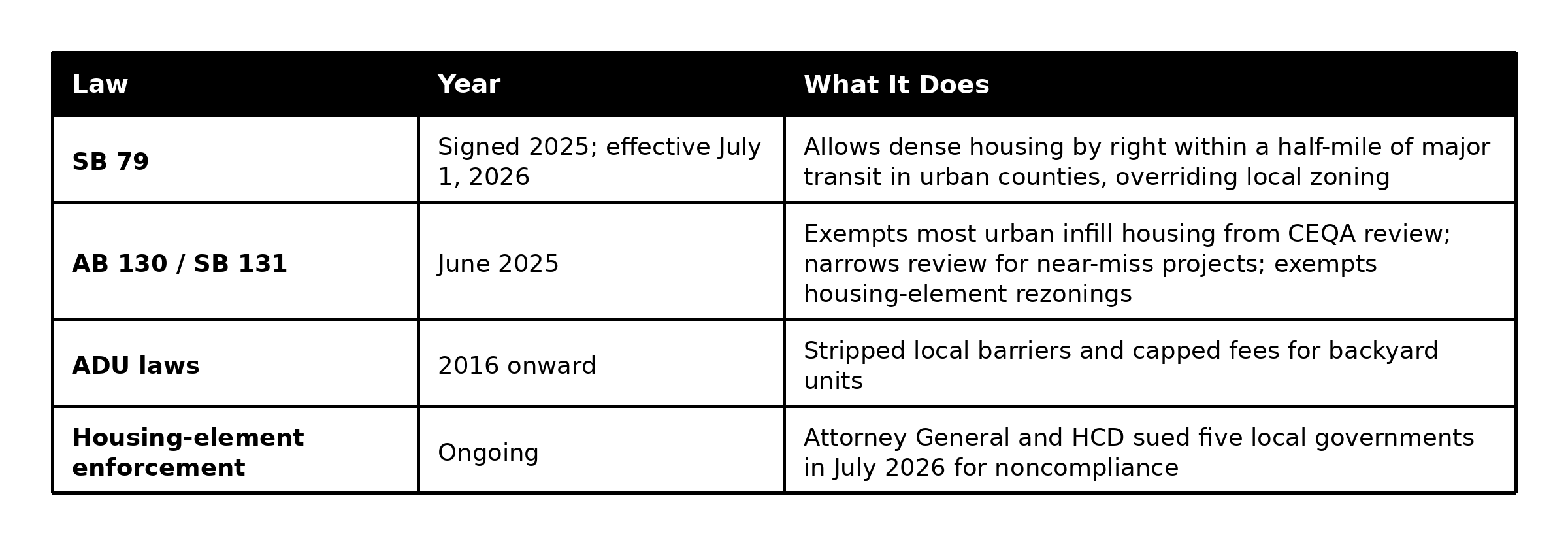
There is also public funding under consideration.
Publication update needed: The original draft states that Proposition 1 was on the November 3rd ballot and would authorize an $11.25 billion housing bond, including $10 billion for affordable rentals and homeownership and $1.25 billion for CalVet home loans. This section should be updated with the election result before publication.
What Do the Numbers Actually Show?
Here is what I find most telling: When California gets out of the way, builders show up.
Consider accessory dwelling units, or ADUs—the backyard units appearing throughout the state. Permits increased from 1,269 in 2016 to more than 24,000 in 2022. Today, California permits approximately 25,000 ADUs annually.
That is nearly one in every four new homes, and it required very little direct taxpayer funding.
However, the state’s larger reforms have not yet appeared in the overall housing totals.
Permitting activity is declining. Monthly permits fell from 10,196 units in May 2026 to 8,285 in July, representing a 17.3% decline. Small projects containing one to four units account for approximately 59% of this year’s permits. Large apartment developments are where the state continues to fall short.
Affordable housing remains far behind. Halfway through the current planning cycle, fewer than 10% of the required low- and very-low-income units had been permitted. By comparison, nearly half of the required higher-income units had been permitted.
Rents have stabilized, but they have not significantly declined. Average California rents eased from approximately $2,800 in late 2025 and remained near $2,700 throughout the summer.
There are several important factors to keep in mind.
SB 79 only took effect on July 1, and the new CEQA exemptions are barely a year old. It is still too early to measure their full effect.
High interest rates, tariffs on construction materials and labor shortages are also slowing development across the country—not only in California. Regulation explains a significant part of the state’s housing problem, but it is not the entire story.
What This Means for Multifamily Investors
Let’s talk about apartments, because that is where many of these regulations have the greatest effect—and where there may currently be significant opportunity.
First, the good news: Los Angeles apartments are performing better than some headlines suggest.
According to Matthews’ Q2 2026 report, Los Angeles is on pace for its largest year of new apartment deliveries since 2000, while vacancy remains below 5%.
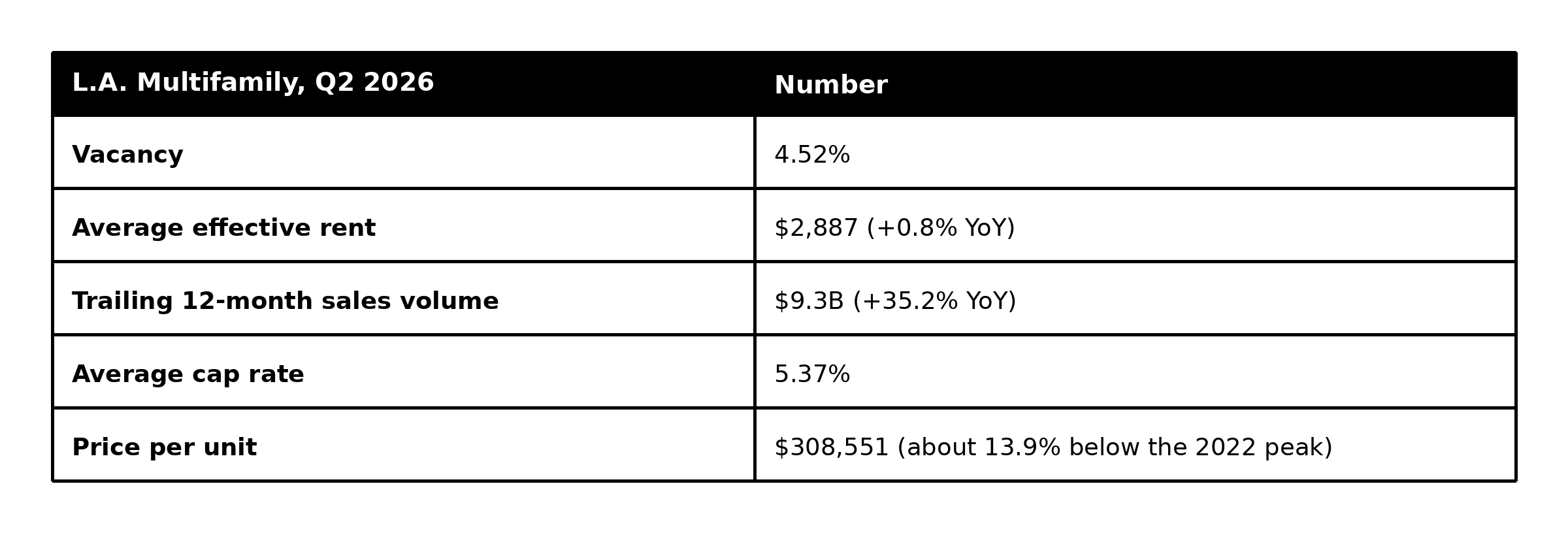
Investors are returning to the market, and many are purchasing properties at a discount from peak pricing.
Capitalization rates have increased for six consecutive quarters, suggesting that pricing has reset. If you have been waiting on the sidelines, that is worth watching.
However, multifamily buyers in Los Angeles must also account for several challenges.
Measure ULA
The City of Los Angeles’ so-called “mansion tax” imposes an additional 4% tax on transactions above approximately $5.3 million and 5.5% on transactions above approximately $10.6 million. It applies to apartment buildings and other commercial properties—not only mansions.
A UCLA and RAND study estimates that the measure is costing Los Angeles at least 1,910 new apartment units each year. Supporters note that the measure has generated nearly $1.2 billion for affordable housing, while an Occidental College reanalysis found no decline in permits.
In July, the Los Angeles City Council shelved a ballot measure that would have exempted new apartment buildings. For now, Measure ULA remains in place.
The bottom line: Account for it in your exit strategy.
Rent Caps
AB 1482 generally limits annual rent increases to 5% plus inflation for many buildings more than 15 years old. Older Los Angeles properties may also fall under the city’s stricter rent-stabilization regulations.
Multifamily investors should underwrite future rent growth accordingly.
SB 79 Development Potential
If an apartment property is located within a half-mile of a qualifying major transit stop, the underlying land may now be more valuable as a development site than the existing building.
That possibility can significantly change the value-add calculation.
CEQA Relief
Qualifying infill apartment projects may now avoid much of the traditional environmental review process, potentially removing a significant amount of risk, expense and time from ground-up development.
My advice? The best multifamily opportunities today may be as much about the land as the existing building.
Know the zoning. Know the transit map. Know the property’s Measure ULA exposure before submitting an offer.
Why This Matters in Commercial Real Estate
Here is the part many people overlook: These are not solely housing laws.
Several of these measures can effectively transform commercial land into potential residential land, changing how investors, owners and brokers should evaluate property.
A Tired Strip Center Near Transit May Have New Potential
SB 79 allows qualifying housing on certain sites zoned for residential, mixed-use or commercial purposes when they are located within a half-mile of qualifying transit stops.
An aging retail center near a Metro station may now offer a residential redevelopment opportunity.
Mixed-Use Development Could Become Easier
AB 130’s CEQA exemption can apply to qualifying mixed-use projects where at least two-thirds of the space is residential.
A project featuring retail on the ground floor and apartments above may now face a more streamlined development process.
Development Incentives May Stack
In Los Angeles, qualifying projects may be able to combine SB 79 provisions with incentives available through the city’s Citywide Housing Incentive Program, or CHIP.
That combination could further increase the development potential and value of certain properties.
Local Implementation Still Matters
Some cities have moved to temporarily pause aspects of SB 79 while developing their own transit plans, and certain public agencies are seeking exemptions.
Always review current local regulations before underwriting a development site.
For commercial real estate brokers, this creates an opportunity: Identify owners whose properties may have gained housing or redevelopment potential without their knowledge.
That is a conversation worth having.
Who Is the Largest Landowner in Southern California?
Here is a question I am often asked: Who owns the most land in Southern California?
Is it the City of Los Angeles? Los Angeles County? The Los Angeles Unified School District?
The answer depends on how the land is counted. If all ownership is considered, the answer is none of the above.
The largest landowner in Los Angeles County is the federal government. The Angeles National Forest alone covers approximately one-quarter of the county’s total land area.
Among the three local public entities most commonly mentioned, the comparison looks like this:
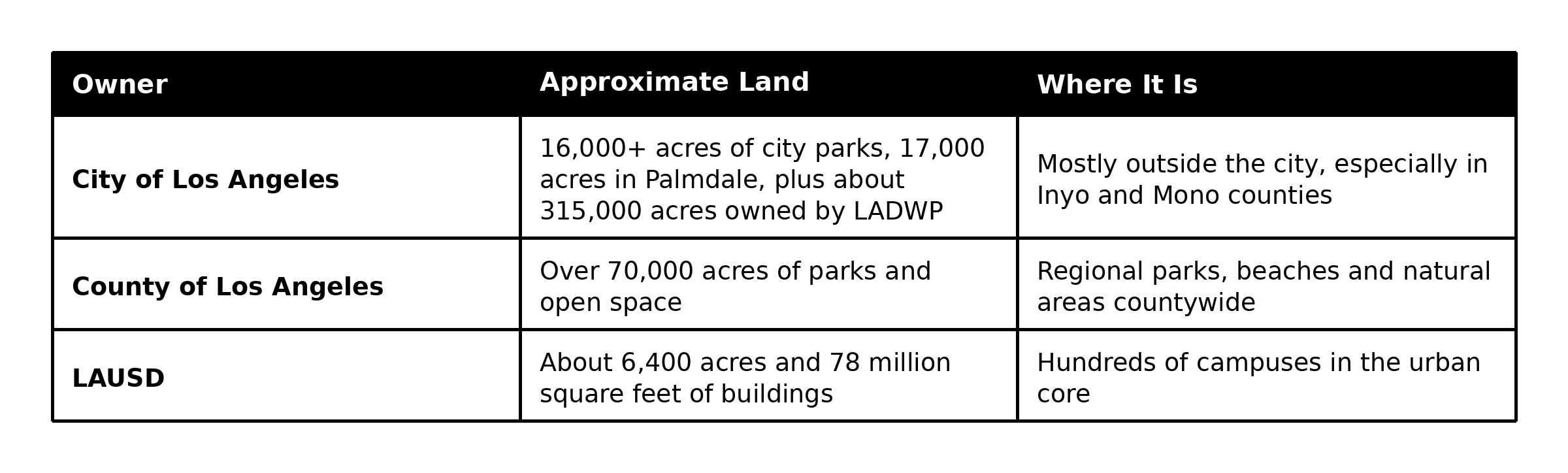
By total acreage, the City of Los Angeles is the clear leader, largely because of land and water rights acquired in the Owens Valley more than a century ago—the history famously associated with Chinatown.
However, much of that property is located hundreds of miles from Los Angeles.
Here is the important distinction: LAUSD is frequently described as the largest landowner in Los Angeles County because its approximately 6,400 acres are located within the urban core, often on flat, buildable and already-developed sites.
For housing development, that is the land that may matter most.
LAUSD appears to recognize that opportunity. The district recently advanced plans for 598 income-restricted apartments across two surplus sites in Woodland Hills and West Hollywood, using long-term ground leases rather than selling the land.
Statewide, school districts own approximately 75,000 acres of potentially developable land. Researchers estimate that this land could accommodate as many as 2.3 million homes.
For multifamily developers and investors, publicly owned land may be one of the most overlooked opportunities in Southern California.
Ground leases with LAUSD, the city or the county can potentially remove the upfront cost of purchasing land from the development equation. That can be transformative in a market where land is often the single greatest obstacle to making a project financially feasible.
My Take
Are California’s regulations hurting or helping the housing market?
Looking backward, the old system of slow approvals, high fees, CEQA litigation and local vetoes clearly helped create the current shortage.
Looking forward, the state’s newer laws are clearly attempting to address it. The rapid growth of ADUs demonstrates that when California meaningfully removes barriers, property owners and developers respond.
Important questions remain.
Can SB 79 and the recent CEQA reforms generate meaningful housing production while interest rates and construction costs remain elevated? Should California reconsider certain tenant protections and development fees, or are those safeguards necessary to keep people housed while new supply catches up?
Smart people arrive at different conclusions.
The next several years of permitting and construction data will likely answer more of these questions than any debate can.
I would love to hear your perspective. If you own property near public transit or within an infill location, now may be an ideal time to understand what that property could become.
Reach out to start the conversation.
Sources
RAND study summary, via California YIMBY
UCLA Anderson Forecast, California Construction and Housing Update, July–August 2026
Diamond, McQuade and Qian, rent-control study in San Francisco, National Bureau of Economic Research
California Department of Housing and Community Development, SB 79 Transit-Oriented Development
Greenspoon Marder, California’s recent CEQA reforms
Los Angeles City Planning, SB 79 Fact Sheet
Terner Center, AB 1482 brief
Bipartisan Policy Center, ADUs in California
CalMatters, California housing goals
Urbanize LA, RHNA progress report
Matthews, Los Angeles Multifamily Market Report, Q2 2026
Bisnow, Los Angeles City Council decision regarding the Measure ULA multifamily exemption
Los Angeles City Chief Legislative Analyst, Measure ULA studies
Occidental College, reanalysis of permitting activity following Measure ULA
Los Angeles County General Plan, Conservation and Natural Resources Element
Los Angeles Department of Water and Power, Inyo County land divestment
Los Angeles City Council District 4, LAUSD Community School Parks
CRE Daily, LAUSD affordable housing plan