
Bringing an International Brand to America

How Commercial Brokers International Launched Lorna Jane Activewear in Southern California
By Joe Killinger, Partner of Commercial Brokers International
Lorna Jane is an Australian women's activewear brand headquartered in Brisbane, Queensland, founded in 1989 by Lorna Jane Clarkson. This white paper documents how Commercial Brokers International (CBI) guided the brand's entry into the United States retail market — the strategy behind site selection, the results achieved, the impact of the COVID-19 pandemic on the U.S. rollout, and the lessons that now inform CBI's work with other international brands seeking a foothold in the American market.
Executive Summary
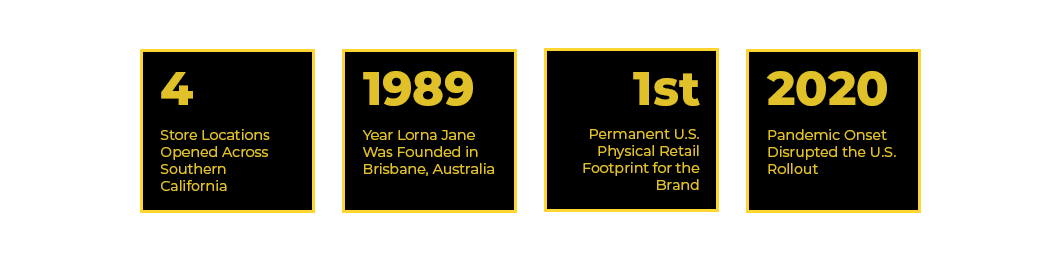
Commercial Brokers International (“CBI”) partnered with Lorna Jane, a 1989-founded Australian women's activewear brand headquartered in Brisbane, Queensland, to establish its first physical retail presence in the United States. CBI identified and secured four store locations across Southern California, targeting neighborhoods and lifestyle centers with high foot traffic, strong walkability, and an affluent, health-conscious consumer base — the exact demographic profile that had driven Lorna Jane's success in Australia.
The four stores opened successfully and gave Lorna Jane its first true beachhead in the U.S. market. However, the onset of the COVID-19 pandemic in 2020 — and the indoor mall closures, capacity restrictions, and collapse in foot traffic that followed — created financial pressure that the young U.S. operation could not absorb. Lorna Jane ultimately closed its U.S. retail locations.
The Lorna Jane engagement remains one of CBI's clearest examples of what it takes to bring a foreign brand to American consumers — and what can happen when a well-executed strategy meets a once-in-a-century market shock.
The experience sharpened CBI's approach to international retail expansion and now directly informs the firm's ongoing work with other overseas brands entering the U.S. market.

About Lorna Jane
Founded in 1989 by Lorna Jane Clarkson in Brisbane, Queensland, Lorna Jane grew into one of Australia's best-known women's activewear brands, built around a lifestyle philosophy the brand calls “Active Living.” By the time it began exploring U.S. expansion, Lorna Jane had an established retail footprint across Australia and a loyal, fitness-oriented customer base — but no permanent physical presence in the United States, the world's largest activewear market.
Entering the U.S. represented a significant opportunity for the brand: access to a much larger addressable market and validation on a global stage. It also represented significant risk. American retail real estate, consumer behavior, lease structures, and competitive dynamics differ meaningfully from the Australian market, and missteps in market entry — particularly around store location — are difficult and expensive to reverse.
The Challenge: Entering an Unfamiliar Market
Bringing an overseas retail brand into the United States is not simply a matter of finding available square footage. It requires a working knowledge of local demographics, walkability and foot-traffic patterns, competitive retail clustering, lease negotiation norms, landlord relationships, and how a specific consumer profile behaves differently market to market. For Lorna Jane, CBI needed to find locations where Southern California's fitness and wellness culture would recognize and embrace the brand immediately.
This is the core challenge international brands face when entering the U.S. — They typically have deep expertise in their home market and their product, but little on-the-ground insight into U.S. commercial real estate. CBI's role was to close that gap.

Market Entry Strategy
CBI built its site-selection strategy around the same consumer profile that had made Lorna Jane successful in Australia: active, health-conscious, and community-oriented shoppers who spend time — and money — in walkable, lifestyle-driven retail environments. Every location considered for the U.S. launch was evaluated against a consistent set of criteria:
High organic foot traffic, both pedestrian and vehicular, sufficient to build brand awareness without relying solely on paid marketing;
Strong Walk Score ratings, reflecting neighborhoods where shopping is part of a daily routine rather than a destination trip;
Affluent, health-conscious demographics aligned with Lorna Jane's core customer — areas with high concentrations of fitness studios, healthy dining, and wellness-oriented retail;
Upscale lifestyle centers and open-air retail corridors, rather than traditional enclosed malls, to reinforce the brand's premium, active-lifestyle positioning;
Co-tenancy and adjacency, siting stores near complementary brands and fitness/wellness anchors that would draw the right customer past the storefront.
This framework guided CBI to Southern California specifically — a region whose climate, fitness culture, and retail geography closely mirrors the environment in which Lorna Jane had thrived at home.
Execution: Four Southern California Locations
Working directly with Lorna Jane, CBI identified, negotiated, and secured four retail locations across Southern California that met the firm's site-selection criteria. Each location was selected individually rather than as a template rollout, with CBI evaluating the specific trade area, walkability, and tenant mix of every site to ensure it matched the local customer base to Lorna Jane's brand positioning.
The four stores gave Lorna Jane a genuine physical presence in the U.S. market for the first time — fitting rooms, in-person styling, and community events that a website alone could not replicate. It was, for a period, a successful proof of concept that an Australian activewear brand could translate directly to the American consumer when the real estate strategy was built around the right neighborhoods.
The Pandemic Impact
The U.S. launch coincided with the onset of the COVID-19 pandemic. Lockdowns, restrictions on indoor mall operations, and a sharp, sustained drop in foot traffic across the retail environments that had made the site-selection strategy work in the first place undercut the very fundamentals Lorna Jane had targeted. The high-traffic, walkable, lifestyle-center model is highly effective in normal conditions — but it also depends on people being out, active, and shopping in person, which the pandemic eliminated almost overnight.
The resulting revenue loss across all four locations created financial pressure the newly established U.S. operation could not sustain. Lorna Jane ultimately made the decision to close its United States retail locations. Although they still continue operations in Australia and online.
The site-selection strategy was sound — it was the pandemic, not the market fit, that closed these doors. That distinction matters, and it shapes how CBI structures every international expansion today.
Lessons Learned
The Lorna Jane engagement reinforced several principles that now shape how CBI approaches international brand expansion into the U.S.:
Demographic and lifestyle alignment is necessary but not sufficient — site selection must be paired with lease structures and contingency planning flexible enough to absorb macro shocks;
Open-air lifestyle centers reduce certain risks relative to enclosed malls, but no format is immune to a market-wide disruption in foot traffic;
International brands can benefit enormously from a local real estate partner who understands not just where to locate stores, but how to negotiate for foreign companies entering the U.S. market, landlord relationships, co-tenancy protections, and exit terms specific to the U.S. market;
A phased rollout — rather than opening several locations simultaneously — can give an international brand more room to adjust before scaling further.
These lessons are now embedded directly into how CBI structures every new brand's U.S. market entry, from initial site strategy through lease negotiation.

A Specific Skill Set for International Brand Launches
Bringing a brand from another country into the U.S. market — and doing it well — requires a distinct combination of capabilities: fluency in U.S. commercial real estate markets, an outside perspective on brand positioning, cross-cultural understanding of how a brand's identity will read to an American consumer, and the relationships needed to move quickly on the right locations. This is not a generalist brokerage service; it is a specialized discipline that CBI has built and continues to refine.
Since the Lorna Jane engagement, CBI has continued working with other international brands pursuing U.S. expansion, applying the same disciplined, demographic-driven approach to site selection — refined by the real-world lessons of launching during one of the most disruptive periods in modern retail history.

Scaling the Model: The CRE Affiliate Network
The Lorna Jane engagement made clear that a single brokerage — however well connected — has natural limits when a brand's growth plan extends beyond one metro area. A market entry strategy built for Southern California does not automatically translate to Texas, the Pacific Northwest, or the Southeast; each region has its own demographics, landlord relationships, and retail geography, even the way they structure leases. To solve this, CBI founded the CRE Affiliate Network, a national network of independent commercial real estate brokerages that gives expanding brands access to local, on-the-ground expertise in markets across the country.
Rather than relying on a single office to cover the entire United States, brands working with CBI can tap into the CRE Affiliate Network's footprint of independent brokerages, each with deep knowledge of its own local market, landlord base, and consumer profile. The network operates on a no-annual-fee, referral-fee model, so brands and affiliate brokerages align around shared outcomes rather than upfront membership costs. The CRE Affiliate model offers CBI clients:
Local market expertise in every region a brand wants to enter, without CBI needing an office on the ground in each city;
A consistent, vetted standard of service across affiliate brokerages, so a brand's experience stays cohesive as it scales;
A referral-based structure that keeps incentives aligned between the brand, CBI, and the local affiliate handling each market;
Quicker response times, and ability to quickly gather, review and analyze locations around the country to make the right decision for the next market to expand into, and a planned roll-out across the country;
A built-in path from a single successful market — like Lorna Jane's Southern California launch — to a coordinated, multi-region growth plan.
For a brand that has proven its concept in one U.S. region and is ready to expand further, the CRE Affiliate Network turns that single success into a repeatable, nationwide growth engine — without sacrificing the local market knowledge that made the first launch work.
Considering a U.S. Market Entry?
If you lead a brand outside the United States and are evaluating an entry into the U.S. retail market, Commercial Brokers International has the team, the process, and the hands-on experience — including the successes and the hard-won lessons — to help you get on the right track.
Let's talk about your U.S. expansion.
Whether you're launching your first U.S. location or planning nationwide growth, Commercial Brokers International has the experience and network to help you scale with confidence. Learn more and connect with an experienced CRE advisor today at CBICommercial.com.