
Understanding the CRE Capital Stack: How Smart Financing Can Increase Returns
By George Pino, CEO of Commercial Brokers International

Commercial real estate investing is often described in terms of purchase price, rent, occupancy, cap rate, and cash flow. But truly savvy investors understand that there is another concept that can have just as much impact on an investment’s success: the capital stack.
The capital stack is simply the combination of financing sources used to purchase or develop a property.
Understanding how those layers work can help investors evaluate risk, structure better deals, and potentially increase returns.

What Is a Capital Stack?
Think of the capital stack as a financial ladder.
At the bottom are the sources of capital that have the highest priority for repayment and generally the lowest risk. As you move higher up the stack, investors take on more risk—but they also expect higher returns.
A CRE capital stack might look like this:
1. Senior Debt
A traditional mortgage or property loan. The lender usually has the first claim on the property if the borrower defaults.
2. Mezzanine Debt
A higher-risk loan that sits behind the senior lender. Because it is riskier, it typically carries a higher interest rate.
3. Preferred Equity
Capital that sits between debt and common equity. These are typically preferred investors that usually receive a minimum contractual return before common equity receives distributions.
4. Common Equity
The sponsor and/or investors who own the remaining economic interest in the property. Common equity takes the greatest risk but generally has the greatest potential upside.
A Simple Example
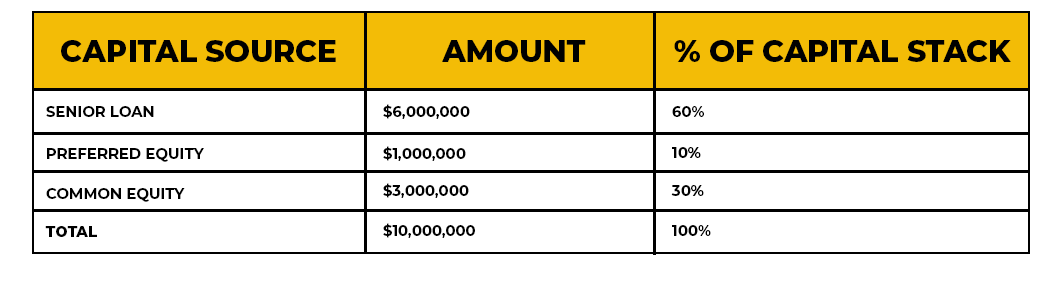
Imagine an investor purchases a $10 million property.
The capital stack could look like:
A smart investor isn't simply asking:
"Can I buy this property?"
Instead, the better question is:
"What combination of capital allows me to acquire and operate this property while producing a potentially better return without taking excessive risk?"

Why Does the Capital Stack Matter?
The capital stack determines who gets paid first, who takes the most risk, and who receives the upside.
This becomes particularly important when a property performs differently than expected.
If the property generates strong cash flow and appreciates significantly, the common equity investors may capture substantial upside.
If the property struggles, however, the senior lender generally gets paid before everyone else. Preferred equity and common equity absorb losses before senior debt.
That creates an important relationship:
More risk generally means greater potential return.

How Leverage Can Increase Returns
One of the biggest reasons investors buy real estate and use debt is leverage.
For example, an investor purchases a $10 million property with $10 million of cash. If the property increases in value by 10%, it is now worth $11 million.
The investor made $1 million on a $10 million investment—a 10% return, before considering income, transaction costs, and other factors.
Now assume the investor uses $6 million of debt and invests only $4 million of equity.
If the property still increases by $1 million, that $1 million increase represents a 25% increase relative to the original $4 million equity investment, before accounting for the cost of debt and other factors.
This is the power of leverage.
But leverage works both ways.
If the property loses $1 million in value, the equity investor can experience a much larger percentage loss.
That is why leverage should never be viewed simply as a way to "boost returns." It is a tool that amplifies both gains and losses.

The Capital Stack Can Create More Than Just Leverage
Sophisticated investors can use different layers of the capital stack to accomplish different objectives.
For example, a developer may use:
Senior debt to fund the majority of the project
Mezzanine debt to fill a financing gap
Preferred equity to bring in additional capital
Common equity to retain ownership and participate in the upside
This allows investors to structure transactions that might otherwise be difficult to complete.

The Key Is Matching Risk With Capital
Not every property should have the same capital stack.
A stabilized, fully leased industrial property might support a relatively conservative senior loan.
A vacant office building with significant repositioning potential might require more equity because the property has greater operational and leasing risk.
A ground-up development might require substantial equity because there is construction, lease-up, market, and financing risk.
The capital structure should therefore reflect the risk profile of the asset.
Finding the "Sweet Spot" of the Capital Stack
The goal isn't necessarily to use the most debt possible.
The goal is to find the optimal capital structure.
Too little debt may result in lower equity returns because too much investor capital is tied up in the property.
Too much debt can create:
Excessive interest expense
Restrictive loan covenants
Refinancing risk
Potential problems during a downturn
The sweet spot is where the investor can use leverage to improve equity returns without creating an unacceptable level of risk.

Capital Stack Optimization in the Real World
Imagine an investor is purchasing a $20 million office building that is currently underperforming.
The investor believes they can improve occupancy, increase rents, reduce expenses, and ultimately increase the property's value to $28 million.
Instead of simply financing the property with a traditional mortgage, the investor might structure:
$12 million senior loan
$2 million preferred equity
$6 million common equity
The investor now has enough capital to execute the business plan while limiting the amount of common equity required.
If the property reaches the projected $28 million value, the common equity investors may benefit significantly from the increase in value after satisfying the senior debt and preferred equity obligations.
This is where capital stack structuring becomes an investment strategy, rather than simply a financing decision.
The Bottom Line
The capital stack is more than a financing diagram.
It is the risk-and-return architecture of a commercial real estate investment.
When used properly, debt, preferred equity, and common equity can allow investors to acquire larger properties, preserve capital, fund value-add strategies, and potentially increase returns.
But leverage isn't free, and more leverage doesn't automatically mean a better investment.
The best CRE investors understand that returns are created not only by buying the right property, but also by structuring the right capital stack.
Considering Buying or Refinancing Commercial Real Estate?
If you’re considering buying or refinancing any commercial real estate, reach out to us at info@cbicommercial.com and ask to speak to one of our advisors.