
How to Build Your Own Commercial Real Estate AI Agent with Claude

You can build your own AI application to maximize productivity in commercial real estate brokerage
The commercial real estate industry has always been driven by relationships, but behind every successful deal is a significant amount of time spent on analysis, documentation, and communication. Brokers regularly review offering memorandums, analyze leases, draft LOIs, research comps, and prepare client updates. In many cases, this can take three to four hours per deal just on preparation.
That is beginning to change.
We are seeing a clear shift. Brokers who are adopting AI tools like Claude are not replacing their expertise. Instead, they are enhancing their ability to move faster, communicate more effectively, and focus on the parts of the business that actually drive revenue.
The Agent Framework — Architecture & Design
The Four-Layer Agent Architecture
Layer 1: Input Ingestion
The agent must accept multiple types of inputs across a deal's lifecycle. A well-designed CRE agent handles:
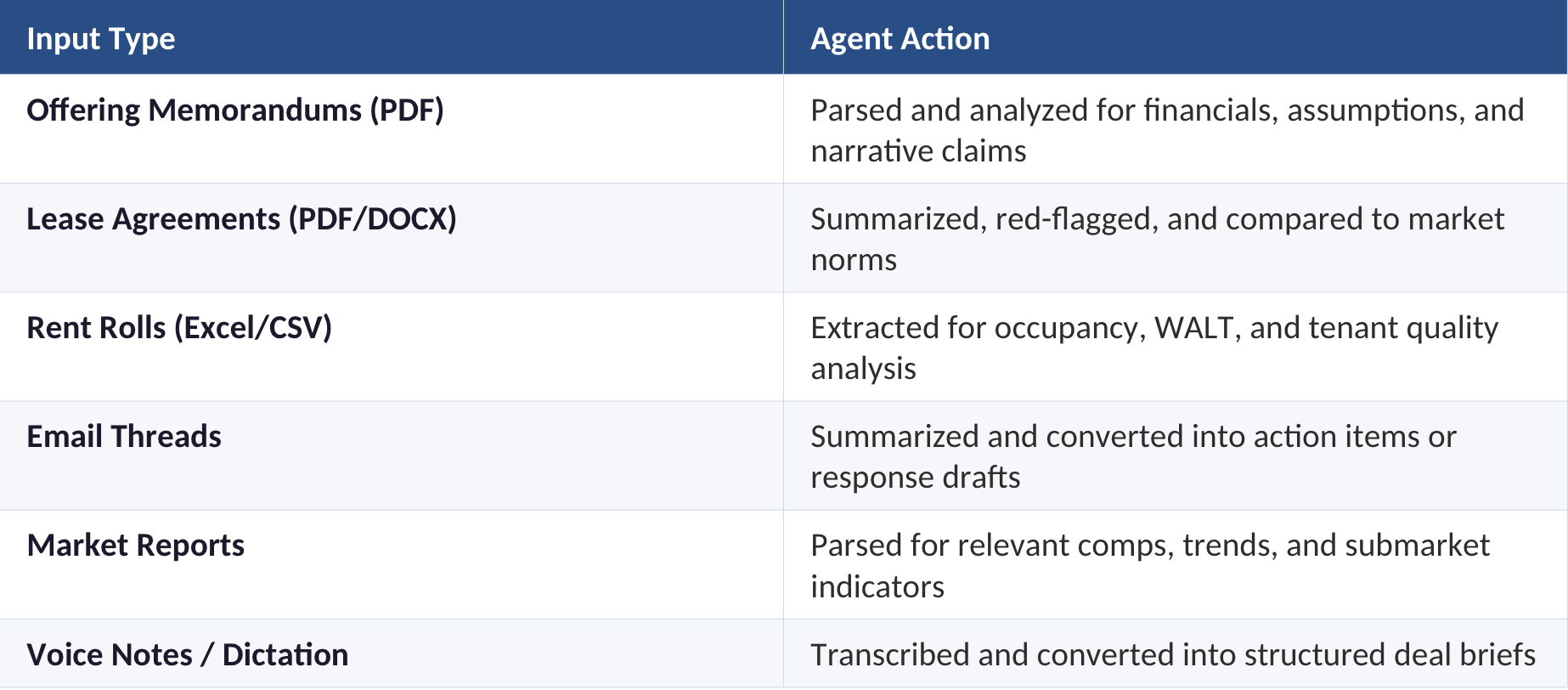
Layer 2: The Task Router
When you upload a document, Claude first identifies its type (OM, lease, rent roll, financial statement). It then selects the appropriate analysis template, extracts the relevant data fields, and runs the task. This means you do not need to specify 'analyze this as an OM' — the agent infers it from context.
Layer 3: The Five Sub-Agents
Each sub-agent is a specialized prompt + workflow designed for a specific task category in the CRE deal lifecycle.
Sub-Agent 1: The Underwriting Analyst
This agent handles all financial document analysis. It extracts NOI, cap rates, rent roll data, debt terms, and key assumptions — then outputs a standardized deal scorecard that can be compared across opportunities.
• Inputs: OMs, financial statements, rent rolls, loan term sheets
• Outputs: Standardized scorecard, red flag report, due diligence question list
• Best for: Investment associates, acquisitions teams, solo investors
Sub-Agent 2: The Lease Review Agent
Trained on standard commercial lease structures across office, industrial, retail, and multifamily asset classes. Summarizes key terms, identifies non-standard clauses, and flags anything that deviates materially from market norms.
• Inputs: Full lease documents, lease abstracts, LOI drafts
• Outputs: Plain-English summary, red flag list, comparison to standard market terms
• Best for: Tenant rep brokers, landlord reps, asset managers
Sub-Agent 3: The Market Research Agent
Uses Claude's web search capability to pull real-time submarket data, tenant news, competitive property information, and macroeconomic indicators. Packages findings into a structured, ready-to-present market brief.
• Inputs: Submarket name, asset class, property address, tenant name
• Outputs: Market snapshot (vacancy, rents, absorption), tenant profile, competitive set analysis
• Best for: Listing presentations, investment committee memos, broker opinions of value
Sub-Agent 4: The Document Drafting Agent
The highest-volume sub-agent for most users. Handles all outbound writing: LOIs, proposal responses, OM narratives, marketing copy, investor letters, lender communications, and meeting follow-ups.
• Inputs: Deal parameters, property specs, deal terms, audience description
• Outputs: Polished, audience-appropriate written documents
• Best for: Brokers, investor relations professionals, asset managers
Sub-Agent 5: The Portfolio Reporting Agent
Synthesizes portfolio-level data into performance summaries, pipeline reports, and investor-ready narratives. Tracks deal milestones and generates alerts when deals stall or key deadlines approach.
• Inputs: Portfolio spreadsheets, occupancy data, financial summaries, deal status notes
• Outputs: Weekly pipeline reports, quarterly LP updates, asset-level performance briefs
• Best for: Fund managers, portfolio managers, investor relations teams
Layer 4: Output Delivery
The final layer structures and delivers outputs in the format most useful to the professional. Depending on the workflow, this may be:
• A formatted Word document or PDF ready for distribution
• An email draft ready to review and send
• A structured data file (CSV/Excel) for import into a financial model
• A CRM entry or task update pushed to an external system
• A Slack or Teams message summarizing key findings for team review
How to Build It — The Technical Stack
You do not need to be a software engineer to deploy a basic version of this agent. Below is the full technical stack, organized from no-code to fully custom.
Option A: No-Code (Start Here)
Use Claude.ai directly in your browser. No setup required. This handles 80% of the use cases described in this guide.
• Go to claude.ai and start a conversation
• Upload PDFs (OMs, leases, rent rolls) directly into the chat
• Use the prompt templates from Section 6 of this guide
• Enable web search in Claude's settings for the Market Research Agent use cases
• Copy outputs into Word, email, or your CRM
Begin with the Lease Review Agent use case — upload your next lease abstract and ask Claude to summarize key terms and flag red flags. Most CRE professionals report this single use case alone saves 1–2 hours per week.
Option B: Lightweight App (2–4 Weeks)
Build a simple web application using Claude's API that your whole team can use. This enables consistent prompt templates, persistent deal history, and team-wide access.
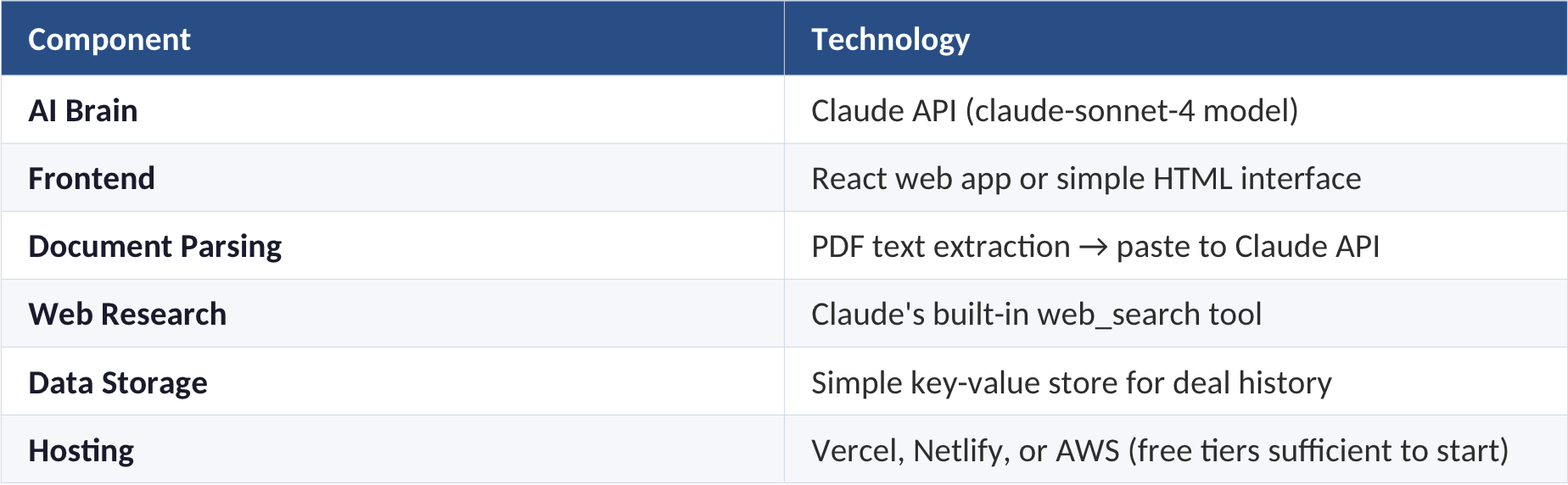
Of course, you can always build further from here and bring your agent to an enterprise level - which may take months when resources permit.
What AI Will Not Replace
It is important to recognize that AI does not replace the core responsibilities of a broker. It does not build relationships, negotiate deals, or earn trust with clients. Those elements remain entirely dependent on the broker’s experience and skill. AI implementation nowadays is also far from fully applicable in all aspects, especially when it comes to formatting, regulations, and confidential information. It always comes back to the brokers themselves to either initiate these tasks and/or make amendments.
What AI does is remove the time-consuming tasks that support those activities. It allows brokers to focus more of their energy on strategy, relationships, and execution.
The future of commercial real estate will not be defined by access to AI. These tools are becoming widely available. Instead, it will be defined by how effectively professionals integrate them into their daily workflows.
At Commercial Brokers International, we believe that the most successful brokers will be those who can move quickly, communicate clearly, analyze deals thoroughly, and scale their efforts without sacrificing quality.